!
Latest updates
Hua Hin Airport (HHQ): one scheduled route, and the international plan
Updated 15th Oct 2026
Surat Thani Airport (URT): the mainland way to Koh Samui, Koh Phangan and Koh Tao
Updated 15th Oct 2026
U-Tapao Rayong-Pattaya International Airport (UTP): who runs it and what is being built
Updated 15th Oct 2026
Nakhon Si Thammarat Airport (NST): the 2023 terminal, airlines and getting into the city
Updated 15th Oct 2026
Hat Yai Airport (HDY): terminals, getting into town and Bangkok flights
Updated 15th Oct 2026
Chiang Rai Destination Guide
Updated 6th Sep 2026
Chiang Rai is a provincial capital in Thailand's far north, close to the borders with Myanmar and Laos. Founded in 1262, it held the Lanna kingdom's capital for about six years before the seat of power moved on, reaching Chiang Mai in 1296. This guide covers the city's temples, the day trips into the surrounding hills and how the seasons affect a visit.
Getting there by air
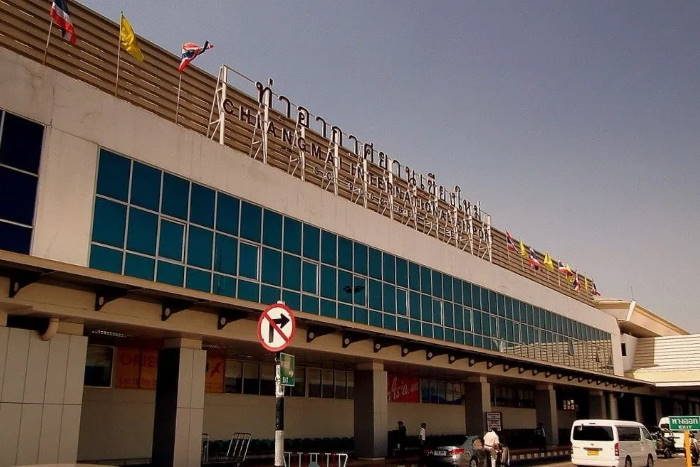
Flights to Chiang Rai land at Chiang Rai Airport. Its own page covers the terminal and how to get from it into town.
This site carries schedules for the Bangkok route in both directions: Bangkok to Chiang Rai and the return leg, Chiang Rai to Bangkok.
Chiang Rai's geography and climate
Chiang Rai province covers 11,503 square kilometres in Thailand's far north, bordering Myanmar's Shan State and Laos's Bokeo province. The Mekong River forms the boundary with Laos, and the Mae Sai and Ruak rivers mark the border with Myanmar. Doi Tung, the province's most significant peak, reaches 1,389 metres.
The province has three seasons: a cool season from November to February, a hot season from March to May that can reach the mid-thirties Celsius, and a monsoon from around May or June to October.
Burning season runs from December to April, with air quality usually improving after mid-April once the rains start. Academic sampling in Chiang Rai between January and April 2021 measured fine particulate matter (PM2.5) averaging 47.39 micrograms per cubic metre over the whole period, above the 37.5 microgram 24-hour limit Thailand adopted in June 2023. Anyone sensitive to air pollution, or visiting for the mountain views, is better off coming in November, before the burning starts.
Temples and sights in Chiang Rai city
Wat Rong Khun, known as the White Temple, is a contemporary temple designed by the Thai artist Chalermchai Kositpipat, about 15 kilometres south of the city on Phahonyothin Road. Construction began in 1997, and the artist, who has funded much of it himself, has said the project will not be finished until around 2070. Anyone visiting should expect an active building site alongside the completed sections.
Wat Rong Suea Ten, the Blue Temple, was built by a student of the White Temple's designer. Construction started in October 2005 and finished in 2016, and the temple is about ten minutes from the city centre with no resident monks.
Baan Dam Museum, known as the Black House, is a private art museum built up from the mid-1970s by the artist Thawan Duchanee, who died in 2014. It mixes traditional northern-Thai buildings with dark, unconventional structures on the theme of mortality, and was completed in 1996.
The Clock Tower in the city centre was designed by Chalermchai Kositpipat, the White Temple's architect, and erected in 2008. It runs a light-and-music show in the evening, reported at 19:00, 20:00 and 21:00; check locally, since show times change.
Wat Phra Kaew, in the city, is where a chedi struck by lightning is said, by tradition, to have revealed the Buddha image now known as the Emerald Buddha. That image was later moved to Bangkok, so what remains here is the discovery story rather than the object itself.
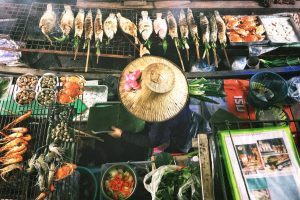
Chiang Rai's night bazaar runs daily near Bus Terminal 1, reported from early evening until around 23:00. Two weekend walking streets add stalls: Saturday's on Thanalai Road and Sunday's on San Khong Noi Road, both running from late afternoon or early evening until around 22:00 or 23:00, though the exact times vary between sources.
Day trips from Chiang Rai
The Golden Triangle, known locally as Sop Ruak, is the point in Chiang Saen district where the Mekong and Ruak rivers meet, forming the tripoint between Thailand, Laos and Myanmar. The name dates to 1971, coined by an official at the United States Department of State referring to the region's history in opium production.
The Hall of Opium museum, in Golden Triangle Park, is reported open Tuesday to Sunday, closed on Mondays. Published closing times disagree between sources, so check before travelling. A smaller House of Opium nearby is often confused with it; the two are separate museums.
Doi Mae Salong, later renamed Santikhiri, was settled from 1961 by former soldiers of the Republic of China's 93rd Division after China's civil war, and its residents received Thai citizenship in 1978. The area shifted from opium to tea cultivation in the 1980s and is now known for its oolong tea.
The Doi Tung Development Project, run by the Mae Fah Luang Foundation, converted an opium-growing area into tea, coffee and handicraft production. The Foundation's own account of the project dates its start to January 1987.
Phu Chi Fa is a mountain viewpoint on the Thailand-Laos border, about 90 kilometres and two to three hours' drive from the city. A short walk of 20 to 30 minutes leads to the viewpoint itself, known for a sea of mist at sunrise; the best months are November to February.
Singha Park, also known as Boon Rawd Farm, is a large agricultural park about 12 kilometres from the city, built around tea and coffee fields with cycling routes and a zip line. It hosts the Singha Park International Balloon Fiesta, an annual hot-air-balloon festival typically held in February.
Hill-tribe village tours: a caution
Some tours from Chiang Rai include a stop at a fenced, pay-to-enter "long-neck village", where women from Karen communities wear neck rings for visitors to photograph. Travel writers who have visited these attractions report that the women are often brought in for the day and do not live on the site; they have called the practice a "human zoo".
A trekking or homestay tour that works directly with a hill-tribe community is the alternative to a fenced photo stop. When booking, ask how a tour is structured as well as where it goes.
Festivals in Chiang Rai
Chiang Rai holds its own flower festival around late December and early January. Local Loy Krathong events run in addition to the national holiday, usually in October or November.
Both move from year to year, so check the current dates locally rather than assuming last year's.
Frequently asked questions
How many days do you need in Chiang Rai?
The main city sights fit into a day: the White Temple, the Blue Temple, the Black House and the Clock Tower can all be seen from the centre. The province's day trips, such as the Golden Triangle, Doi Mae Salong or Phu Chi Fa, each take most of a day on their own. Two or three days lets you combine the city with one or two of the outlying trips without rushing.
When is the best time to visit Chiang Rai?
The cool season, from November to February, has the most comfortable temperatures, and November is its one month outside the burning season. Burning runs from December through April, so anyone visiting for mountain views in that window should expect reduced visibility. The hot season, March to May, and the monsoon, from around May or June to October, are the alternatives if the cool season does not fit your dates.
Is Chiang Rai worth visiting?
Chiang Rai combines the White Temple's decades-long construction, the Golden Triangle's river confluence and hill country day trips such as Doi Mae Salong and Phu Chi Fa. It suits a traveller who wants temples and hills rather than beaches, with at least a day for the city and ideally more for the day trips. It is a poor fit for a short stopover with only a few hours to spare, given how spread out the day trips are.