!
Latest updates
Hua Hin Airport (HHQ): one scheduled route, and the international plan
Updated 15th Oct 2026
Surat Thani Airport (URT): the mainland way to Koh Samui, Koh Phangan and Koh Tao
Updated 15th Oct 2026
U-Tapao Rayong-Pattaya International Airport (UTP): who runs it and what is being built
Updated 15th Oct 2026
Nakhon Si Thammarat Airport (NST): the 2023 terminal, airlines and getting into the city
Updated 15th Oct 2026
Hat Yai Airport (HDY): terminals, getting into town and Bangkok flights
Updated 15th Oct 2026
Getting Around Bangkok
Updated 3rd Sep 2026
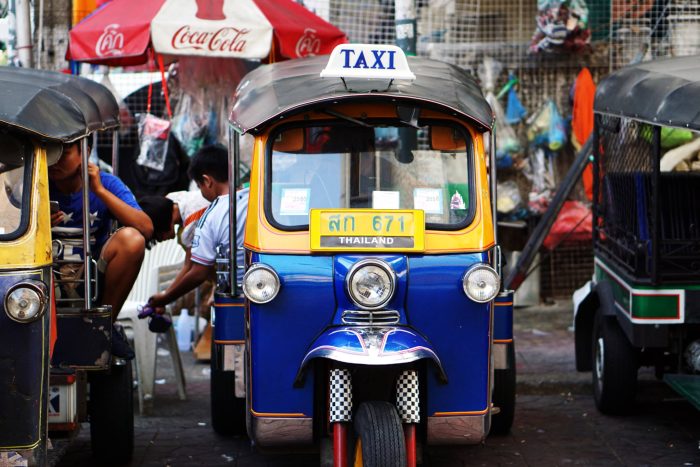
Bangkok has two rail networks that do not share a ticket, a river service that runs a reduced pattern at weekends, and two rush hours a day on the roads. This page covers how a visitor actually moves around inside the city: which mode suits which trip, how each one is paid for, and what tends to go wrong.
Which mode suits which trip
For a journey across the middle of the city, the rail lines are the dependable choice, because an elevated or underground train is not held up by whatever the road below is doing. Sukhumvit Road is the clearest case, since the BTS Skytrain, operated by Bangkok Mass Transit System, runs the length of the road it competes with.
Road traffic is typically at its worst between about 07:30 and 09:30 and again between about 17:00 and 19:30. There is a quieter window in the middle of the day, roughly 10:30 to 15:30, when a taxi or a bus makes better progress. A motorcycle taxi is the usual answer to a short hop that would otherwise sit in a queue of cars.
The rail networks stop somewhere between midnight and 01:00 and the boats stop in the evening, so a late journey generally means a taxi, a ride-hailing car or a motorcycle taxi. With a large suitcase, a taxi is easier than either train at any hour.
Which line reaches which part of the city matters more than which network it belongs to. The districts these lines serve are covered in the Bangkok destination guide, and the lesser-known places among them in some hidden gems of Bangkok.
The BTS Skytrain
The two original lines, Sukhumvit and Silom, cross at Siam. The operator's own published service hours run from 05:00 to 01:00, effective from 1 January 2026, with the last trains out of Siam shortly after midnight.
There are two ways to pay: a single journey card bought as a token from a machine or a counter, and the Rabbit stored-value card. Both are tapped on the way in and again on the way out. If a gate rejects the ticket, if it is damaged or lost, or if more than 300 minutes have passed since you tapped in, the ticket office deals with it rather than the gate.
The Rabbit Card is topped up at BTS ticket offices, at MRT Yellow Line and Pink Line ticket offices, at vending machines, through LINE Pay, and at some McDonald's and Tesco Lotus branches. It also covers the Gold, Pink and Yellow lines, which makes it a BTS group card rather than a citywide one.
On luggage, the operator's regulations set no maximum size and instead prohibit anything that cannot be carried without risk of damage or nuisance to other passengers, which leaves the decision to station staff. Non-folding bicycles are prohibited outright, and small animals in bags are not permitted.
Lifts are fitted at some stations rather than all of them, concentrated at interchanges and terminus stations. Mo Chit, Siam, Asok, On Nut, Chong Nonsi and Bang Wa are among those named as having them, and Siam is described as fully accessible. A step-free route is worth planning station by station before you set out rather than assuming one.
The MRT Blue and Purple Lines
The Blue Line, run by Bangkok Expressway and Metro, runs from Tha Phra to Lak Song across 38 stations on the operator's own list. Tao Poon is the interchange with the Purple Line, and that change happens inside one system at one fare, without leaving the paid area.
Operating hours are reported as roughly 06:00 to midnight on the Blue Line, with first trains from around 05:30 on weekdays. The Purple Line is reported as 05:30 to midnight on weekdays, shifting to 06:00 to midnight at weekends and on public holidays. The MRT Information Centre is open 07:00 to 20:00 on weekdays and 08:00 to 17:00 at weekends and on public holidays.
The MRT and MRT Plus stored-value cards no longer work. Online top-ups stopped on 1 April 2026 and the cards themselves stopped working on 1 June 2026, with any remaining balance refundable at a Blue Line or Purple Line ticket office until 31 December 2027.
What replaced them is a contactless Visa or Mastercard from any bank, a debit card from certain Thai banks, including Krungthai, Krungsri and UOB, the MRT EMV card, or a single-trip token bought at the station for one journey.
One card does not cover both networks
The Rabbit Card works on the BTS Sukhumvit and Silom lines and on the Gold, Pink and Yellow lines, and it does not work on the MRT Blue or Purple lines. The MRT side takes bank cards and tokens instead. Every change between the two networks therefore means tapping out of one and paying separately into the other, with no through-fare.
Bangkok's rail lines were built under different agencies, each with its own ticketing technology behind it. A genuinely unified single ticket has been planned since 2016 and is targeted for 2027, so it is a plan rather than something a visitor can use today.
A capped flat fare across Bangkok's electric rail lines took effect in October 2025, and eligibility was restricted to Thai nationals who register with a thirteen-digit national identity number. A visitor pays the ordinary distance-based fare instead.
Changing between the BTS and the MRT
Interchange here means the two stations are close together or physically joined, not that one ticket covers both. They are not all the same shape, and the difference matters most when you are carrying something. The walking times below are reported by independent accounts rather than published by either operator.
| Change | What it involves |
|---|---|
| Asok (BTS) to Sukhumvit (MRT) | An underground walkway between the two, without surfacing to the street, taking roughly three to five minutes gate to gate. |
| Sala Daeng (BTS) to Si Lom (MRT) | A covered elevated walkway, one of the original links built when the MRT opened. It involves stairs, which matters with a case. |
| Mo Chit (BTS) to Chatuchak Park (MRT) | Different in kind. Reported as a change at street level outside the fare gates, rather than a covered link between them. |
| Bang Wa | A name shared between two separately run stations, not a single interchange. Leaving one network and entering the other here works the same as anywhere else on this table. |
| Phaya Thai (Airport Rail Link) to the BTS Sukhumvit Line | Connected at the station. |
| Makkasan (Airport Rail Link) to Phetchaburi (MRT) | A skywalk from Makkasan Exit 2, about 166 metres and five to eight minutes on foot. |
| Hua Mak (Airport Rail Link) to the MRT Yellow Line | Connected at the station. |
Mo Chit to Chatuchak Park is the one to allow extra time for. Of the Airport Rail Link's connections to the rest of the network, the Makkasan to Phetchaburi skywalk is the one reported as wheelchair accessible.
Boats on the river and the canal
The Chao Phraya Express Boat runs four flag lines: Orange, from Nonthaburi to Rajsingkorn; Yellow, from Nonthaburi to Sathorn; Green Yellow, from Pakkret to Sathorn; and Red, from Nonthaburi to Sathorn. The blue flag tourist boat is a separate brand and is not one of them.
Only the Yellow Flag line runs at weekends, and Orange, Green Yellow and Red are Monday to Friday services. On Saturdays the Yellow Flag runs from Nonthaburi from roughly 07:30 to 17:00, and from roughly 08:40 to 17:00 on Sundays and public holidays.
Boats do not wait long at a pier, so boarding is quick and often means stepping on while the hull is still moving against the landing. That is ordinary practice on the river rather than a sign that something has gone wrong.
The Khlong Saen Saep canal boat is a separate system, run by a company called Family Transport since 1990 over an 18 kilometre route with around 100 boats. The route splits at Pratunam pier, with a western line ending at Wat Saket and an eastern line ending at the National Institute of Development Administration (NIDA). Hours are given as 05:30 to 20:30 on weekdays, closing earlier at about 19:00 at weekends.
It is fast because it ignores the roads entirely, and it is not comfortable. Passengers pull up plastic side curtains to keep the canal water off, the water is visibly dirty, boarding and getting off are done quickly at the pier edge, and the boats are crowded at rush hour.
Taxis, ride-hailing and motorcycle taxis
Refusing a passenger and refusing to run the meter are both illegal, and enforcement is visible. In an April 2026 case a traffic police officer warned a driver near Don Mueang on camera after a refusal, and penalties escalate on repeat offences as far as cancellation of the licence. Complaints about a refusal or a meter go to the Department of Land Transport hotline, 1584.
Ride-hailing in Thailand is licensed. It was legalised in 2021, and from 31 March 2026 tighter rules required drivers to hold a public driving licence and to pass background checks. In the city a driver waits at a pickup point agreed inside the app rather than being flagged down, and may telephone to confirm the exact spot.
A registered motorcycle taxi rider wears a numbered vest tied to one stand and one zone, and the vest may not be lent or sold. Vests are most often orange but can also be pink, blue, purple or green depending on registration. Each carries a district and a number, and newer ones are printed in English as well as Thai.
Most stands have a shaded waiting area and a board listing destinations, usually written in Thai and sometimes with roman lettering added. A board does not guarantee a fixed price. A tuk-tuk is a road vehicle and sits in the same traffic a car does, and the motorcycle taxi is the mode chosen specifically to get past it.
Walking and the skywalks
The skywalk from Siam BTS station east to Chit Lom is proper infrastructure rather than an informal shortcut, and it is free to use. It passes the Ratchaprasong junction and carries on by skybridge to the Central Chidlom department store, taking roughly ten minutes end to end and sheltered from sun, rain and street traffic.
It is one instance of a wider pattern, in which covered elevated walkways link several central BTS stations to each other and to adjacent shopping centres. They cover the central shopping and business corridors rather than the city as a whole, so away from those corridors getting between two points on foot means street level and crossing roads built for traffic.
Heavy rain and street flooding
A heavy afternoon downpour can flood roads within twenty to thirty minutes, and it happens often enough to plan around. On 9 June 2026 flooding hit Phahon Yothin Road near Kasetsart University BTS station, and on 31 May 2026 around 88 millimetres of rain flooded parts of Pathumwan district, including Rama I Road near CentralWorld.
In each of those cases the rail line kept running while the road below it did not. If heavy rain starts while you are in a taxi, the line overhead is likely to be the faster way to finish the trip.
September and October are the worst months for it, when runoff from the north and high tides on the river coincide with the tail of the rainy season and reduce the city's ability to drain.
Getting to and from the airports
Ground transport at each airport is covered on that airport's own page rather than here: Suvarnabhumi Airport (BKK) and Don Mueang International Airport (DMK). Moving between the two is a separate problem with a guide of its own, on transfers between Suvarnabhumi and Don Mueang.
Frequently asked questions
Does a Rabbit Card work on the Bangkok MRT?
No. The Rabbit Card covers the BTS Sukhumvit and Silom lines and the Gold, Pink and Yellow lines. The MRT Blue and Purple lines take a contactless bank card, an MRT EMV card or a single-trip token instead, so a change between the two networks means paying twice.
Can I still buy an MRT stored-value card in Bangkok?
No. The MRT and MRT Plus stored-value cards stopped working on 1 June 2026, and online top-ups had already stopped on 1 April 2026. A balance left on one can be refunded at a Blue Line or Purple Line ticket office until 31 December 2027.
Do the Chao Phraya express boats run at weekends?
Only the Yellow Flag line does. The Orange, Green Yellow and Red flag lines are Monday to Friday services. On Saturdays the Yellow Flag runs from Nonthaburi from roughly 07:30 to 17:00, and from roughly 08:40 to 17:00 on Sundays and public holidays.
Can a Bangkok taxi driver refuse to use the meter?
Not legally. Refusing the meter and refusing a passenger are both illegal, and penalties escalate on repeat offences as far as cancellation of the licence. Complaints go to the Department of Land Transport hotline, 1584.
How does a Bangkok motorcycle taxi rank work?
Riders work from a fixed stand covering a set zone, and a registered rider wears a numbered vest that may not be lent or sold. Vests are most often orange but can also be pink, blue, purple or green, and each carries a district and a number. Most stands have a board listing destinations, usually in Thai, and the presence of a board does not guarantee a fixed price.
When is Bangkok traffic at its worst?
Typically between about 07:30 and 09:30 and again between about 17:00 and 19:30, with a quieter middle of the day roughly between 10:30 and 15:30. Heavy rain can add to it at any hour, and it is the streets that flood rather than the rail lines above and below them.