!
Latest updates
Hua Hin Airport (HHQ): one scheduled route, and the international plan
Updated 15th Oct 2026
Surat Thani Airport (URT): the mainland way to Koh Samui, Koh Phangan and Koh Tao
Updated 15th Oct 2026
U-Tapao Rayong-Pattaya International Airport (UTP): who runs it and what is being built
Updated 15th Oct 2026
Nakhon Si Thammarat Airport (NST): the 2023 terminal, airlines and getting into the city
Updated 15th Oct 2026
Hat Yai Airport (HDY): terminals, getting into town and Bangkok flights
Updated 15th Oct 2026
U-Tapao Airport (Pattaya, Rayong)
Updated 15th Oct 2026
Departures from U-Tapao Airport (Pattaya, Rayong) at a glance
- 3flights a day22nd busiest of 30 airports
- 3routes from here
- 2airlines
- 13:00 – 17:25first and last
Collected 26 October 2026. Not live — check with the airline before booking.
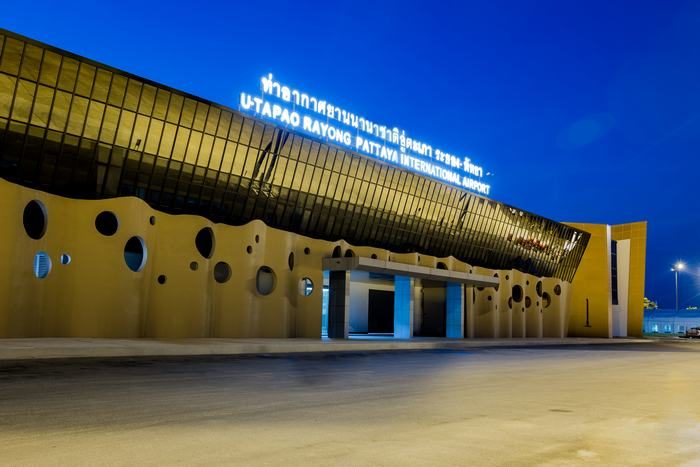
U-Tapao Rayong-Pattaya International Airport (UTP) is a Royal Thai Navy airfield in Rayong province that also handles commercial flights. It serves Pattaya and Rayong rather than a town of its own, and the operator gives the distances as 39.1 km to Pattaya City and 60.1 km to Rayong, so it is closer to Pattaya than to Rayong.
Who runs U-Tapao Airport
On 21 February 1989 the Cabinet resolved that the Ministry of Defence, through the Royal Thai Navy, and the Department of Commercial Aviation would jointly administer U-Tapao as an international commercial airport. On the operator's own account the Navy took finance, air traffic control, navigation aids, procurement and security, and the civil side took flight procedures and airport development.
That department was the predecessor of Thailand's later civil aviation bodies, so its name is not one in use today; the Navy reorganised the civil side twice more, ending with the body the operator calls the U-Tapao Airport Authority.
The 2020 concession
Since 2020 a private consortium, U-Tapao International Aviation Co., Ltd. (UTA), has held a fifty-year concession to develop and run an expanded airport and an adjoining Eastern Aviation City, as the lead project of Thailand's Eastern Economic Corridor (EEC). Its shareholders are Bangkok Airways and BTS Group with 40 per cent each, and Stecon Group with 20 per cent.
The contract was signed on 19 June 2020 and the Notice to Proceed issued on 3 April 2026: five years between signature and first construction.
What is being built at U-Tapao, and what is not
Construction began on 3 April 2026, and the Royal Thai Navy is building the second runway and its taxiways. Accounts calling this expansion something the government is still considering are out of date. Work has started, though most of the plan has not.
Open today are Passenger Terminal 1 and Passenger Terminal 2, which the Eastern Economic Corridor Office puts at a combined capacity of roughly 3.7 million passengers a year, and one runway of about 3,500 metres. The office publishes the scope of the rest on its own U-Tapao page.
| Part of the project | Status, August 2026 |
|---|---|
| Passenger Terminals 1 and 2 | Open |
| Second runway and taxiways, 3,505 m | Under construction, targeted for May 2028 |
| Passenger Terminal 3 | Not built. First phase expected to take three to four years from the April 2026 start |
| Passenger Terminal 4 | Awaiting its own Notice to Proceed |
| New air traffic control tower | Preparations under way |
| Maintenance, repair and overhaul zone | Operator still being selected |
| Cargo and logistics centre | Awaiting its own Notice to Proceed |
| High-speed rail station | Awaiting its own Notice to Proceed |
The Eastern Economic Corridor Office sets a long-term goal of up to 60 million passengers a year by 2048, rising to 70 million once the second runway is in use. That is a multi-decade planning figure, not the airport anyone will fly into soon. Terminal 3's own first-phase target was cut back to roughly 3 to 4 million a year from an earlier 12 to 15 million.
The high-speed rail station meant to serve the airport is still waiting on its own Notice to Proceed, so plan on reaching U-Tapao by road.
Which airlines fly from U-Tapao Airport
The two obvious sources disagree, and neither is dated well enough to settle it. The operator publishes an airline contact directory of 17 carriers, many of them Russian and Chinese airlines that look like charter or seasonal operators, and it gives no date of revision. A third-party schedule aggregator tracks two carriers with live scheduled routes.
On that aggregator's reading, Bangkok Airways flies year-round to Koh Samui and Phuket, and Thai Lion Air flies seasonally between October and March to Chiang Mai and Udon Thani. That is one company's tracking, not a statement by the airport, so read the airline off your own booking.
The operator's own website also lists the Ezy Airlines winter 2026 schedule, with direct flights from U-Tapao (UTP) to the airports coded URT and HHQ.
The operator's own figures for 2025 are 369,610 passengers and 5,730 aircraft movements.
Where this site holds flights from U-Tapao
This site files its schedule pages for the airport under Pattaya rather than U-Tapao, worth knowing if you searched the airport name and found none. Three airport pairs have pages, each in both directions:
- Pattaya to Phuket and Phuket to Pattaya
- Pattaya to Koh Samui and Koh Samui to Pattaya
- Pattaya to Chiang Mai and Chiang Mai to Pattaya
Pattaya itself is covered in the Pattaya destination guide.
How do I get to and from U-Tapao Airport?
The airport names the companies working there on its own transport pages. Car hire is S.M.T. Rent A Car Company Limited, the single firm named on both the transport page and the operator's car rental partner page, and the counters open from 08:00 to 20:00. For public transport the operator names Suvarnabhumi Burapha Company Limited, Vanatana Company Limited, Loma Pattaya Taxi Co-Operative Ltd and BH Rayong Limited Partnership.
The operator's current list names one company.
There are three car parks, Parking Lot 1, 2 and 3, with a ten-minute grace period for drop-off and pick-up. The airport's own pages then disagree about when charging starts: its parking page charges a vehicle staying more than 30 minutes from entry, while its facilities page says 10 minutes. Ten is the safer assumption.
Facilities at U-Tapao Airport
The operator lists cash machines, a clinic, free Wi-Fi, prepaid SIM card sales, a wheelchair service, currency exchange, self-service check-in kiosks and a value-added tax refund counter. The prayer room is in Passenger Terminal 2, on the ground floor next to domestic arrivals.
That facilities page carries no English version, so the detail behind the list is published in Thai.
How U-Tapao became a commercial airport
The American military built the airfield during the Vietnam war. Construction began in October 1965, the runway became operational on 6 July 1966, and American forces were there until June 1976.
In 2008 protesters occupied and closed both Suvarnabhumi and Don Mueang from late November until 3 December. Some airlines ran limited services out of U-Tapao, which was overwhelmed by the demand.

Most viewed travel guide articles

Thailand Airlines Comparison: Baggage, Bangkok Airports and Who Still Flies

Frequent Flyer Programmes in Thailand: Which Is Worth Joining

Ethical Travel in Thailand: National Park Rules, Wildlife Law and Licensed Operators